7
Recurring Creativity
"Just as painters get the likenesses in their portraits from the face and the expression of the eyes, wherein the character shows itself, but make very little account of the other parts of the body, so I must be permitted to devote myself rather to the signs of the soul in men, and by means of these to portray the life of each, leaving to others the description of their great contests."
— Plutarch, Life of Alexander, 75 CE

The Prometheans
Marsyas and Phaethon belong to a select group of dramatists, artists and musicians who represent Prometheus or, more accurately, it is they who the archetype Prometheus represents. They brought with them the cosmic flame of inspiration after the antediluvian civilisations arose. They are the ones who risk all, at any cost, to bring the light of art to our earth. They suffer as mortal men and women do, but their great works of art endure long after the rest of us are gone again. We cite the following karmic trajectory from El Aurenx:
%2BStaatliche%2BMuseen%2Bzu%2BB.png)
“In the eminence of immortal music, two names tower above all others and rival each other for supremacy — those of Mozart and Beethoven. Beethoven himself admired Mozart and imitated him in his early works, but later in the full force of his own genius he achieved a power of expression surpassing that of all his predecessors and unequalled by any other since. Few suspect that these two have had a long association of similar past lives — as initiates in Atlantis, as dramatists in ancient Greece, and as artists of the High Renaissance..." (Esoteric Biographies, unpublished MS, c.2000)
Wolfgang Amadeus Mozart (1756 – 1791), the Austrian classical composer, was a musical prodigy. He composed and performed music effortlessly and prodigiously since the age of six years. He died prematurely while working on a requiem commissioned by the mysterious emissary of a nobleman. Esoteric legend has it that he was poisoned by the illuminati of Vienna for divulging secret lore in his initiatic opera, 'The Magic Flute'.

Mozart was a reincarnation of the ancient Atlantean initiate, Marsyas, the mythic flute-player. In Greek mythology Marsyas challenges the god Apollo to a contest of music, the winner whereof would punish the loser. The Muses give the victory to Apollo who thereupon flays his victim — whose blood flows as the river Marsyas. This myth, like some others, as I shall shortly show, was used in the initiatic mystery schools to teach the dire results of rashly overreaching oneself in the spiritual quest. Michelangelo Buonarroti (1475 – 1564) was the Italian sculptor, architect and poet who ranks with Leonardo da Vinci as the greatest figures of the Renaissance. He was steeped in Neoplatonic philosophy and was also an initiate of the ancient Mysteries. In his 'Last Judgement' fresco he portrays himself as Marsyas by painting his own face on the flayed figure of St Bartholomew, said to have been martyred in this way. Aristophanes (445 – 385 BCE) was a Greek playwright of satire and comedy. Anyone familiar with the play ‘Amadeus’ will recognise the frivolity of Aristophanes in the character of Mozart. Aristophanes was also an initiate of the Mysteries and indicted for revealing too much of the esoteric doctrines in his plays, like the imprudence of Mozart that reputedly provoked his murder. If Mozart had been a rash, then Beethoven’s was decidedly reckless.

"Ludwig von Beethoven (1770 – 1827) was the German composer who singularly revolutionised musical style from the Classical to the Romantic trends. Despite his deafness he left a monumental musical legacy. He drew his inspiration from above down into the depths of human emotions, but not without tremendous cost to his own soul. In this he was not unlike Prometheus, one of his mythic archetypes, the titan who steals fire from the gods and gives it to mankind, but is punished by being chained to a rock and perpetually preyed upon by a vulture until he is finally freed by Hercules. Beethoven, in his ancient incarnations, had been a reckless initiate who courted disaster in trying to transcend the limitations of his mortal powers, and his deafness was the karmic consequence of his relentless heedlessness.
Beethoven was a reincarnation of the old Atlantean initiate, Phaethon. In Greek mythology Phaethon is the son of Helios, the Sun God. He foolishly tries to drive his father's sun chariot but loses control and sets the world on fire. Zeus intervenes by striking him down with a thunderbolt so that he crashes to earth and dies. This myth was used in the mystery schools to caution candidates against the risks of the initiatic quest. Another such myth is that of Bellerophon who tames the winged horse, Pegasus, and tries to ascend Mount Olympus in defiance of the gods, but is hurled back to earth.

These myths, with their theme of the courageous but tragic hero who defies the gods on behalf of humanity, were first treated dramatically by the ancient Greek tragedian, Euripides (480 – 406 BCE). Unconventional in contrast to his antecedents, Aeschylus and Sophocles, Euripides felt misunderstood, and was even satirised by Aristophanes. But, as Beethoven was to revolutionise classical music, Euripides changed the concept of drama with a new consciousness of realism that challenged the religious and moral myths of his age. He evinced extremes of perspective in his bitterly realistic portrayal of human decadence and depravity alongside his reverence for the virtues of human courage and dignity. Albrecht Dürer (1471 – 1528) was the great artist who uniquely epitomised the Renaissance in Germany. Under the impulse of the Italian Renaissance he transformed the German and Flemish Gothic tradition and created a new artistic reality. His skill was so masterful that the great humanist, Erasmus of Rotterdam, praised him thus: ‘He is able to depict things which cannot really be depicted. It would take very little and he would depict the human voice.’ The rashness of his soul, however, showed itself in a streak of vanity. Nowhere is this more evident than in his 'Self-Portrait' of 1500 wherein he depicted himself in the image of Christ.

As a karmic footnote, it appears that Dürer and Matthias Grünewald had once been father and son, namely Euripides and Euripides the Younger. The young Euripides favoured the formal style of earlier tragedians over the revolutionary style of his father and, above all, favoured the great works by Aeschylus and Sophocles.
Both Aeschylus and Sophocles returned together as contemporary authors, namely Francis Bacon and Christopher Marlowe, and participated anonymously in co-writing Shakespeare's plays and sonnets. These lives were oversouled by El Amenu and Thanatu and include the incarnations of Count Saint-Germain and Dante Alighieri. We'll look at this group in a forthcoming post.
Our primary source for these lives is El Aurenx et al, Esoteric Biographies, unpublished MS, c.2000.

"The life of an age finds its most intimate expression in poetry."
— Rudolf Steiner, Biographies and Biographical Sketches, GA 33,
Lecture 3, c.1900
Steiner’s essay on Literature and Spiritual Life in the 19th Century offers a sweeping overview of modern German authors — from the versatility of Goethe to the radicalism of Nietzsche — and yet his treatment of their English contemporaries is awkwardly scant and sketchy. This post looks at several British-American writers mentioned by him in Biographies and Biographical Sketches, GA 33, Lecture I, originally published in Das Magazin für Literatur (hereafter simply GA 33, 1900). We also draw on our own Transpersonal Lives archive to share what is known about them today.
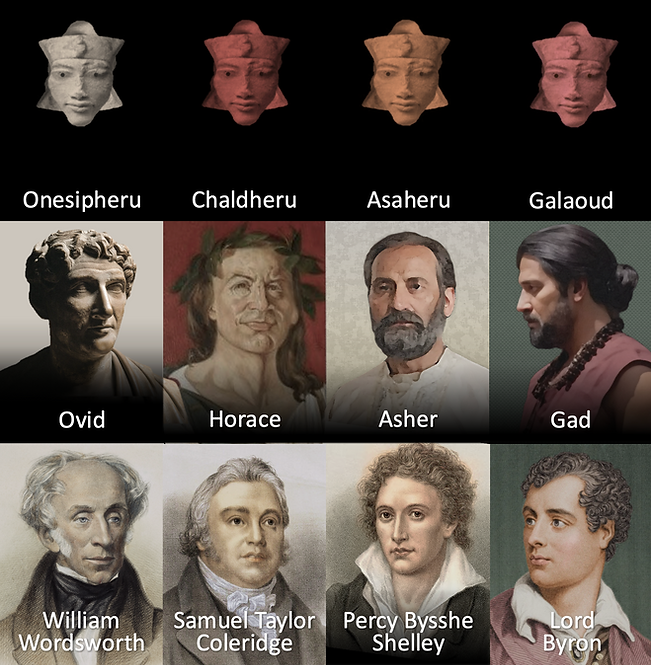
Steiner’s study begins with William Wordsworth and Samuel Taylor Coleridge whom, he says, first broke from Classicism to embrace Romanticism: “The most important of these poets, Coleridge, has much in common with the German Romantics. He too sought out the mystical, the rare in worldly phenomena and lived in a dream world that was alien to reality. Wordsworth was of lesser talent, whose rapture for nature had a somewhat naïve quality, and whose poetry usually destroys the natural tones it strikes with a moralising ending.” Today we know that this ‘lesser’ Wordsworth had once been the great poet Ovid and was oversouled by Onesipheru (El Ochre, 11 June 2005) while, on the other hand, Coleridge was a reincarnation of the poet Horace. Both Coleridge and Horace were oversouled by the Dhuman Chaldheru. (El Ochre, 10 June 2026)
Steiner goes on to discuss Percy Bysshe Shelley and Lord Byron, poets who loved their freedom and defied the limits of their own humanity. The former was full of heart, the latter filled with will: “If one may speak of a philosophy of the heart, then Shelley's poetry must be called by this name [whereas] a sense of storming heaven and hell lived in Byron.” Today we know the two to be the reincarnation of John and James, the sons of Zebedee, whom Jesus called Boanerges; that is, the Sons of Storm”. (Mark 3.17) Before that they were the brothers Asher and Gad, sons of the biblical patriarch Jacob. Their lives are forever intertwined. We now turn to other British-American writers:

Edward Bulwer-Lytton (1803 – 1873)
“Edward Bulwer-Lytton, who in his numerous novels proves himself to be a storyteller of great skill in characterisation and in the composition of plots, vacillated uncertainly between the two. However, the captivating quality of his narrative style stems more from a cleverly calculating mind than from a fertile, creative imagination.” (GA 33, 1900)
In his Philosophy of Freedom (1894) Steiner states that Bulwer-Lytton's esoteric novel Zanoni (1842) contains an imaginative description of the Dweller of the Threshold. It is from Bulwer-Lytton that Blavatsky and Steiner borrowed this term, better known in Theosophy and Anthroposophy today as the “Guardian of the Threshold”.

According to El Ochre (10 June 2026), Edward Bulwer-Lytton had been Pliny the Elder. Edward's son Robert, the famous British statesman, politician and poet, had been Pliny the Younger. The Younger was then the nephew and adopted son of the Elder. Both Plinys witnessed the violent eruption of Vesuvius that destroyed Pompeii. Edward is famous for his novel The Last Days of Pompeii (1834). As Pliny the Elder he died while attempting a naval rescue mission. El Ochre reveals that Pliny the Younger [Robert Bulwer-Lytton] wrote an eye-witness account of the disaster which he dispatched to the historian Tacitus [later reincarnate as Robert Graves]; a source Edward Bulwer-Lytton drew upon for his novel, as well as from the records of Suetonius [previously Herodotus; later Arnold Toynbee]. A tight soul-cluster, karmically and historically.


Joseph Mallord William Turner, Mount Vesuvius in Eruption, 1817.

Ralph Waldo Emerson (1803 – 1882)
According to Steiner, Emerson’s method of writing was to leave books open on chairs and tables from which he would pick out words while walking about the room, taking a phrase from here or there to then formulate his own epigrammatic passages. This curious habit led Steiner to believe that Emerson was a reincarnation of the renowned Roman historian, Tacitus: “And now for the first time we shall grasp wherein the essential greatness of Emerson's style consists, we shall perceive that what Tacitus displayed in his particular way, Emerson again displays in his own special way... Tacitus travels, takes hold of life everywhere; Emerson observes life in books. It all lives again!” (Karmic Relationships, GA 236, Volume II, Lecture III, 23 April 1924) Following El Ochre's recent revelation, we now know that Tacitus returned as the English historian and philosopher of history, Robert Graves, author of I, Claudius (1934).
In turn, we also know that Emerson had been the Persian poet and philosopher Omar Khayyam and, before that, the so-called father of Roman poetry, Ennius. Much earlier, back in the mists of time, he had been the ancient Greek poet Homer. His earliest lives can be traced back to Atlantis where he was known as El Emire, an incarnate Dhuman-Adamic, among the first Sons of God to dwell on earth, and has helped oversoul human evolution ever since. (Onesipheru, 1 June 2024)


Alfred Tennyson (1809 – 1892)
“Alfred Tennyson is an artist of the lyrical form, a light, melodious language, which his poems carried into the widest circles.” (GA 33, 1900)
Tennyson is said to be a reincarnation of the Roman poet Virgil, a contemporary of Ovid (Onesipheru, 31 May 2024). Virgil's lives can be traced back to Arvirilu, a name associated with him since Atlantean times when the Dhumanim incarnated on earth. The ‘Ar-‘ prefixing his name indicates Arvirilu was of the royal line under Arbrahm. Arvirilu is the father of Aristonaiu, also of royal lineage, but better known via his incarnations as Aristotle and Steiner. Steiner himself never identified his kinship to Virgil nor the incarnate Dhuman-Adamic race of Atlantis. However, he did speak of beings descending to earth from cosmic regions during Atlantean times. Curiously, he also spoke about an encounter with his “eternal self” when still a youth of eighteen, but never identified this entity by name. Could it have been his true self, his Dhuman Oversoul, the one called Aristonaiu?


VIRGIL
VIRGIL
Charles Dickens (1812 – 1870)
“But all the characteristic peculiarities of the English spirit at this time are united by the most effective storyteller of this epoch, Charles Dickens, who understood like few others how to create out of the popular soul.” (GA 33, 1900)
According to Onesipheru (1 June 2024), Dickens had previously been Geoffrey Chaucer, the father of English literature, and before that the 2nd century BCE Roman poet Caecilius. Caecilius was in turn an incarnation of the Dhuman oversoul Chalixu or Chaliscu, so named in Atlantis. Onesipheru offers both spellings to show the similarities to the name Charles. Dickens is buried only a few feet from Chaucer's tomb — both are interred in the Poets' Corner at Westminster Abbey. Two bodies, same oversoul.

Caecilius and Ennius, the so-called father of Roman poetry, were close friends and renewed their friendship as Dickens and Emerson. As humans they were friends, as Dhumans they are brothers, Chalixu and El Emire, the two youngest sons of El Ixire. El Ixire also acted as a discarnate spirit guide to his eldest son, El Autonu, then incarnate as Latini, the mentor of Dante. The grandfather of El Ixire, Thanatu, was at that time incarnate as Dante. (Onesipheru, 31 May 2024) A close-knit family.


Walt Whitman (1819 – 1892)
“In Walt Whitman, the American imagination and sensibility found a particularly characteristic expression. From the thoughts he expresses to his treatment of language, everything is modern in the most genuine sense.” (GA 33, 1900)
Regarded as the father of American poetry, Whitman once recalled how, as an earnest teenager, he had discovered the writings of the ancient Stoic philosophers, adding: "It was like being born again." Whitman’s vision — from his pantheism to his transcendentalism — is deeply indebted to Stoicism. Having previously appeared as the legendary Chinese sage and prophet of gentleness, Lao Tzu, he lived quietly and taught Tao by example. This gentle soul is affectionately known through the ages as the Old Wise Man and the Good Gray Poet. Laos, the second son of Enos El Enoch, oversouled Lao Tzu, Diogenes, Epictetus and Whitman. (El Aurenx, Esoteric Biographies, unpublished MS, c.2000)


Rudyard Kipling (1865 – 1936)
“From close observation, Rudyard Kipling depicts Indian-English life in captivating novellas, novels and popular-sounding poems.” (GA 33, 1900) According to our sources, Kipling is today incarnate as Salman Rushdie. (El Aurenx, c.2000)
Steiner’s viewpoint stands in stark contrast to how Kipling is seen today; that is, as “both a champion of British imperialism and too honest not to know its very sordid underpinnings of greed, lies and sheer selfishness.” (Tarik Cyril Amar, 17 May 2026) For Kipling, the Empire deserved to be both great and invulnerable. Significantly, Rushdie himself correctly reflects: “A people that has remained convinced of its greatness and invulnerability, that has chosen to believe such a myth in the face of all the evidence, is a people in the grip of a kind of sleep, or madness.” (Satanic Verses, 1988) It seems Rushdie awoke from Kipling’s sleep.


"The Kipling and Rushdie incarnations involve the oversoul of an Atlantean Dhuman who appeared in ancient India around 20 000 BCE (before the co-Adamic race) and became known as Rudishvaru, meaning the Red God, a reference to his copper skin tone in contrast to the dark-skinned Dravidians of Lemurian origin who were then the aboriginal inhabitants of the subcontinent. The Rig-Veda refers to him as the deity Rudra or Rudra-Shiva, the progenitor (or prototype) of a race of Red Gods." (El Ochre, 10 June 2026)
Kipling cites the Red Gods in his poem, The Feet of the Young Men (1897), saying: "For the Red Gods call me out and I must go." Interestingly, the Valley of the Red Gods on Table Mountain and the Cederberg both take their name from this poem.
Conclusion
Despite its ambitious title, Steiner’s essay on Literature and Spiritual Life in the 19th Century (1900) reveals little regarding the spirituality of British-American poets. He says even less about their incarnations. Nor did he add to their biographies when he presented his research into karmic relationships in the 1920s. As a result, Steiner's observations are of limited value to our present investigation. However, our insights are sourced independently and offer a different perspective; namely that of the oversoul rather than the oversouled.

Our source are three Dhuman siblings from the Osirian corner of the spiritual hierarchy, namely Onesipheru, El Ochre and El Aurenx, better known as the mystics Jakob Böhme, William Law and Laurence Oliphant, whom they oversouled successfully during the 17th – 19th centuries. The three tend to return in succession, as they once did in Egypt when they oversouled Userkaf, Sahura and Neferirkara, the first three pharaohs of the Fifth dynasty. What can be seen among these poets — as too between our three informants — is how intimately souls and their oversouls interact over many lifetimes. Indeed, the spiritual life of an age does find intimate expression in poetry.

"The way to do is to be."
— Lao Tzu, Tao Teh Ching, 6thC BCE

From Taoist to Stoic
Walt Whitman (1819 – 1892) once recalled how, as an earnest teenager, he discovered the writings of the ancient Stoic philosophers: "It was like being born again." (Horace Traubel, With Walt Whitman, 2:71–72).
For him the most important work was the Enchiridion of Epictetus, a compilation of ethical advice and practical precepts, to which Whitman would return throughout his life while revising his own contemplative poetry, Leaves of Grass. Both texts were to be his daily inspiration as a man, a poet and as a mystic.
While scholars have long recognised the influence of classical Stoicism on Whitman’s work, a full account of the extent of this debt has yet to be produced: "[A] number of ideas at the heart of Whitman’s literary vision — his pantheism, materialism, cosmopolitanism, reconciliation of evil and death, and conceptions of both providence and virtue — were strongly indebted to Stoic thought." (Chitrarasu and Hill, 2023)
A karmic overview of his past lives would help, of course, since he was the source of his own inspiration. He was simply paraphrasing himself.
According to Epictetus, all external events are beyond our control so, whatever happens, we should accept it all calmly and dispassionately. However, he adds, all individuals are responsible for their own actions. These we should examine and control through rigorous self-discipline. His teachings were written down and published posthumously by his pupil, Arrian, and influenced later thinkers like Marcus Aurelius (Dag Hammerskjöld). Curiously, Epictetus spent his youth in Rome as the slave of a wealthy freedman who was secretary to Nero. His life thus straddled the lowest and highest in society, the poor and the imperial.


Regarded as the father of American poetry, if not as the greatest of all US poets, Walt Whitman had previously been the esteemed English spiritual writer and contemplative mystic, Walter Hilton (c.1340 – 1396). His best treatise, The Scale of Perfection, is a classic of mysticism not unlike Leaves of Grass with its warm, wise and wondrous words. He was then an Augustine canon, a Cambridge scholar, and ascetic hermit. Already prior to that, as Epictetus, he'd been enslaved, persecuted and exiled (or had left kith and kin to avoid it). His philosophy combined Cynic and Stoic ideals, emphasising freedom, morality and humanity.
Long before that he'd been Diogenes of Sinope (412 – 323 BCE), the wandering Greek philosopher who co-founded the Cynic school. Cynicism was a philosophy based on asceticism, renouncing social conventions, seeking simplicity and self-sufficiency. From the Greek word for a dog, 'cyon', 'cynic' was a derisive epithet for such ascetics who lived as social outcasts, and Diogenes was the most celebrated Cynic of them all. He lived eccentrically on the streets, coarsely clothed, eating scraps. He was openly disdainful of luxurious clothing and acquired learning, exemplifying instead the practical goodness of natural austerity. Far from being despised, he was greatly esteemed and many legends grew around him. Most famously, he wandered the streets in broad daylight saying he was looking for an honest man. Wholly concerned with practical wisdom. he apparently left no literary legacy, although some spurious works were subsequently attributed to him.


"As honest words may not sound fine,
Fine words may not be honest ones.
An honest man does not argue, and
an arguer may not be honest.
The knowers are not learned men,
And learned men may never know."
— Lao Tzu, Tao Teh Ching
Here again we find him paraphrasing himself without pride or pretension. Having previously appeared as the legendary Chinese sage and prophet of gentleness, Lao Tzu, he lived quietly and taught Tao by example. Alas, his example went largely unnoticed. As librarian in the imperial archives he despaired of humanity's spiritual ignorance and resolved to leave China. Legend has it that he was stopped by a guard at the Great Wall and not allowed to pass until he had recorded all his wisdom. It was thus that he wrote the masterly Tao Teh Ching, the so-called Book of the Virtuous Way of Life, a mystical poem of eighty-one verses, upon which his eminence in posterity rests. It is the most celebrated and translated work of all Chinese literature. Having reluctantly committed the incommunicable truth of Tao to writing, he deserted China and headed westward for some unknown destination. Later legend romanticised that he reappeared in India as the Buddha. This is not entirely fabricated. Lao Tzu was actually an incarnation of the Dhuman-Adamic Laosuphu, second son of Enos el Enoch (not to be confused with the biblical prophet), who oversouled the Adi Buddha the Primordial Buddha (shown here). Esoterically, all Buddhas are of this Dhuman-Adamic lineage; that is, direct descendants of Adam el Daoud.
While 'Lao Tzu' is in fact a title, much like 'Caesar' or 'Pope', this is indeed the original legendary Lao Tzu of Tao Teh Ching fame. He is affectionately known through the ages as the Old Wise Man and the Good Gray Poet.
Primary source El Aurenx, Esoteric Biographies, unpublished MS, c.2000.
In his reflections on art and music, Nietzsche observes that both Pindar and Wagner possessed the unique capability of "raising the present into the colossal and eternal".
— Project Gutenberg, eBook 52166


From Epinikia to
Epic Poetry and
Epochal Opera
Steiner refers to the Grail-quest hero in Wagner's Parsifal, as too Wolfram von Eschenbach's Parzival, as a representative of the new Christianity where spirituality overcomes sensuality. (Occult Truths of Old Myths and Legends..., GA 92, no.14, lecture IV, 19 May 1905)
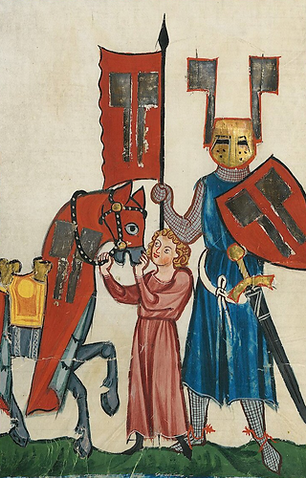
Regarded as the greatest medieval poet of Germany, Wolfram is specifically acclaimed for his esoteric epic, which inspired Wagner. Wolfram also figures as a leading character in Wagner's earlier opera Tannhäuser. According to Laurence Oliver, Wolfram was a former incarnation of Wagner. (Out of Eden, 2001, pp.192–193)
While Steiner doesn't say it directly, he does imply that what lived in Wolfram von Eschenbach found new expression in Richard Wagner: "These were the feelings which lived particularly in the strong personality of Wolfram von Eschenbach. Consider now the new period. Imagine this feeling rising up anew in a period of decadence, and then you will find in it something of what lived in Wagner ... Wagner thus makes a distinction between the descending evolution of the race and the ascending evolution of souls. He felt the necessity of this ascending evolution just as keenly as a medieval soul, just as keenly as Wolfram von Eschenbach." (GA 92.14.IV)
For Wagner, Steiner adds, the hero's descent into darkness and back up to the light mirrors the devolution of race-bound or nation-tied mankind and the evolution of a spirit-inspired mankind. Hence Wagner's call for renewal. A distinction must be made between devolution and evolution, continues Steiner, if one is to understand this development at all. The idea itself can be traced back to the myths and legends of ancient Greece.
According to El Ochre, Wagner was previously incarnate as Pindar, a celebrated lyric poet in the 5th century BCE, whose victory odes (epinikia) were sung and danced by a trained chorus that performed for home-coming athletes in their own city-states. The same genius is quite evident. (disclosed by El Ochre, transcribed by Laurence Oliver, 17 September 2026)


"The history of the world is but the biography of great men."
— Thomas Carlyle, Heroes and Hero-Worship, 1840
Dag Hammarskjöld (1905 – 1961), in a life cut short by circumstances we cannot fathom, still managed to set a benchmark for greatness. Following his tragic death, John F Kennedy said apologetically: “I realise now that in comparison to him, I am a small man. He was the greatest statesman of our century.” (1961)
Three weeks before his ill-fated trip to Africa, Hammarskjöld penned a thought to himself, dated 24 August 1961:
“Is this a new land,
in a different reality from today's?
Or have I lived there,
before this day?”


Death comes to us all, Hammarskjöld knew, but not necessarily at the time of our own choosing: “Do not seek death. Death will find you,” he reflected in his meditative diary (Markings, published posthumously in 1964). Two thousand years earlier, Rome’s wisest emperor Marcus Aurelius wrote virtually the same lines in his Meditations: “It is not death that a man should fear. You will meet it.” Hammarskjöld wanted Africa to have its second chance after colonisation. He wanted Africans to shape their own destiny, eventually. Europe had been through this process itself, three-or-four times before, ever since Attila the Hun came thundering through. Hammarskjöld wanted to give Africa its heart back or, rather, to prevent Congo from being plucked in two. By 1960 the continent had become the great rift valley of the world, divided on the one hand by America and Russia, and on the other by the British, French and Belgians. More than anything else, Hammarskjöld wanted stability, security, and freedom from fear, as well as an end to the Cold War in Africa. In short, world peace and universal order. Plus more silence and time to meditate himself. But the ocean swell had picked him up and so he rose with it. Already in the 1950s, Hammarskjöld had intervened to settle conflicts around the Suez Canal, then a faultline between the West and the East. He also tried to stabilise matters between Israel and the Arab states. How different that could have been today?
Both Kennedy and Nikita Khrushchev shared a dislike for Hammarskjöld’s initiatives; for his ability to shape events beyond their reach. This was not new, of course, as world powers have never liked a Swede with attitude. Remember what happened to Gustavus Adolphus, the celebrated king of Sweden during the Thirty Years War? He resisted the Habsburgs and the conquering Catholics in Europe — and was eventually killed doing so. As Adolphus treated Vienna and Rome, so Hammarskjöld handled Moscow and Washington. He was after all the same soul, one and the same Archon, and he wouldn’t bow to either. Curiously, Adolphus and Hammarskjöld share many attributes, both in life and death. They both died with grass in their hands and, allegedly, a wound to the head. If these allegations are proven true, then both men may have been executed. However, beside their remarkable physical likeness, these two men saw themselves as representing the interests of both the nation and the individual; of the ruling elite as well as the common man: “I am born to live and die for the common good and well-being of my people. My destiny is knotted into theirs.” (Adolphus, Coronation speech, 1617). Hammarskjöld too was a man who bound rulers to their citizens and, like Charlemagne, wove their collective desitiny into an inseparable knot. Charlemagne not only united the isolated peoples of Europe, albeit brutally, but also stabilised East-West relations in a peripheral medieval world. Likewise, Hammarskjöld strove for this in a modern context and today his legacy survives through the Council of Europe. Uncannily, legend has it that both men were found seated after death and in possession of a book, and by some unusual coincidence, Dag Hammarskjöld’s three middle names are phonetically similar to that of Charlemagne = Carl Hjalmar Agne.
We trace his other lives under the Archons of Arcturus, including his link to Augustus Caesar (portrayed here at centre of Charlemagne's cross). Primary source El Aurenx, Esoteric Biographies, unpublished MS, c.2000.