"There is a destiny that makes us brothers:
None goes his way alone
All that we send into the lives of others
Comes back into our own."
— Edwin Markham, written to David Lubin, 1901
8
Recurring
Collaborations
The Sons of Storm
In the Gospel of Mark we read: "James the son of Zebedee and John the brother of James, whom he surnamed Boanerges, that is, Sons of Storm." (Mark 3.17)
The apostles James and John were two brothers whom Jesus called the Sons of Storm (or Thunderbolts in Aramaic) because they represented the zodiacal forces of Aries (fire) and Libra (air). Aries and Libra would together form the lightning (fire) and wind (air) of the thunderstorm ending the age — symbolised by the storm that shook the earth and rent the curtain in the temple during the Crucifixion — marking the earth-world's violent transition from one spiritual age (Aries-Libra) to another (Pisces-Virgo).


James and John were religio-political activists and former Zealots, a fact known to Jesus when he nicknamed them the "Sons of Storm". Neither wrote the New Testament books attributed to them, for they were both killed in 44 CE during the reign of King Herod Agrippa. The Epistle of James was written by James Justus, the brother of Jesus, while the Gospel and Epistles of John were written by the Gnostic disciples of Simon Ananias. The Apocalypse or Revelation was by John of Patmos, who reincarnated as the 19th century poet Victor Hugo, who likewise received communications from disembodied spirits while exiled on the Channel Island of Jersey. James and John, as we shall show, ultimately reincarnated as the Romantic poets Byron and Shelley.
Galaoud and Asaheru were the Dhuman-Adamics who oversouled these lives. Their respective incarnations are shown in parallel rows below.


Gad and Asher
James and John were the reincarnate sons of Jacob, namely Gad and Asher, then full brothers born of Jacob's young concubine Zilpah. The two became patriarchs of the Twelve Tribes of Israel, from which the namesake of their respective tribes derived; also called Gad and Asher. Their own names originated in the sacred lands of Atlantis when they sat at the Round Table of the ruling Atlantean hierarchs. They were then known as Galaoud and Asaheru, ensigns of the zodiacal Aries and Libra, who together with ten other Dhuman-Adamics formed a constellation of twelve around King Arthur (Ar Thur) of Atlantis. They all returned as Arthurian knights in the quest for the Holy Grail, with Gad and Asher appearing as the heroes Galahad and Percival.
Galahad and Percival
The Atlantean-Israelite group of twelve Dhuman-Adamics returned as the twelve princes of the Round Table during the 6th century. The legends surrounding the lives of Galahad and Percival are romanticised, of course, but they were certainly prominent among the Grail knights championing King Arthur's ideals of justice and righteousness in Britain.
Will Scarlet and Allan a Dale
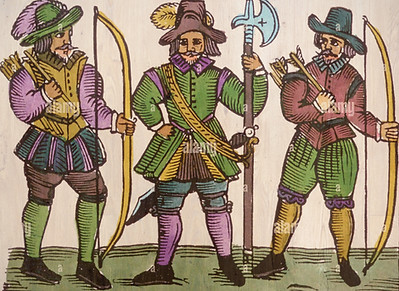
Will Scarlet (Scathlock) and Allan a Dale (A'Dayle) were two of Robin Hood's Merry Men — outlaws who boldly opposed the oppression of the common people by Prince John while his brother, King Richard Lionheart, was away on Crusade. Will and Allan were political activists, once again, not mere minstrels or singing poets as local lore would have it. When John became King of England after Richard's death abroad (1199), the band of Merry Men were hunted down and their woodland hideout destroyed. Will Scarlet and Allan a Dale were both killed during the massacre. Their legend lives on. Depicted in the coloured woodcut are Robin Hood, Little John and Will Scarlet, c.1600.
Edmund Mortimer and Henry Percy
Their next incarnation were as brothers-in-law during the reign of King Richard II of England, namely as Sir Edmund Mortimer (Richard's heir-presumptive) and Sir Henry Percy (Hotspur). After Richard was deposed by Bolingbroke, who then succeeded to the throne as Henry IV, the brothers-in-arms joined the rebellion against the usurper king but the movement was defeated at the Battle of Shrewsbury. Percy was slain while attempting to kill the king on the battlefield (1403); Mortimer died of plague two decades later (1425). Their respective coat-of-arms are shown here.


.png)
Edward and Richard
These two brothers-in-arms came again as the sons of King Edward IV of England: Edward, Prince of Wales, and his younger brother Richard, Duke of York. Edward was only thirteen years old when, on the death of his father in 1483, he became King Edward V. But before his coronation their uncle Richard of Gloucester had the two princes declared illegitimate and usurped the throne as Richard III. Richard had them consigned to the Tower in London and they were not seen again, presumably murdered by Richard III or his successor, Henry VII. They were in fact smuggled to safety and adopted by a French peasant family named Werbecque. Edward then plotted his come-back but succumbed to an untimely death from fever; whereupon his brother Richard took up the cause and appeared as Perkin Warbeck, Pretender to the English throne. Gathering support on the continent, he invaded England and besieged Exeter, but was captured and sent to the Tower. After trying to escape he was hanged. Most historians deny the truth of Perkin Warbeck's claim to have been Richard of York, but they cannot of course know better.
Byron and Shelley
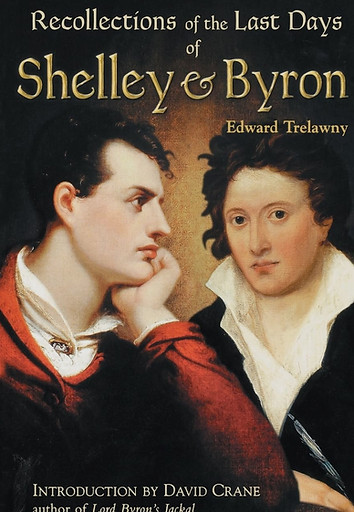
The two great Romantic poets George Gordon Noel, Lord Byron (1788 – 1824) and Percy Bysshe Shelley (1792 – 1822), were close friends and political activists. Byron portrayed his own inner archetypal image in the so-called Byronic Hero of his own poetry — a young man of stormy emotions who shuns society and wonders the world weighed down by guilt feelings for his furtive past sins. As a result, Byron was ostracised by English society for his rumoured incestuous relationship with his half-sister, Augusta, and abandoned England for good, joining the Shelleys in Europe. He eventually joined the Greeks in their revolt against the Turks, where he died of fever.
Shelley, the supremely gifted lyric poet of the English language, was expelled from Oxford University for his bold social and religious views. He upheld a non-conformist moral code deemed immoral by conventional society. After the evident suicide of his estranged first wife, he married Mary Wollstonecraft who became famous as the author of Frankenstein, also called The Modern Prometheus (1818). They spent their last years together in Italy where Percy wrote his major works, including Prometheus Unbound (1820). Byron was a constant visitor and sparring partner. Shortly before Shelley's thirtieth birthday, while sailing home after visiting friends, he was caught in a sudden summer storm and downed.


Primary source via El Aurenx et al, Esoteric Biographies, unpublished MS, c.2000.
8
Recurring
Collaborations
"Some are born great, some achieve greatness, and some have greatness thrust upon them."
— Shakespeare, Twelfth Night, c.1602, II:v
Among those the world considers great, there can be no doubt that William Shakespeare must be named as one of the greatest. His works rank first in the heritage of English literature and second only to the Bible in popular appeal, enduring through four centuries of Western tradition. Yet the true identity of the author of these mighty works is an enigma. Generations of discerning minds have questioned the conventional opinion that the actor from Stratford-upon-Avon, who was one of several William Shakespeares in that era, was the one to whom the authorship referred. Sigmund Freud prudently stated: "The name 'William Shakespeare' is most probably a pseudonym behind which there lies concealed a great unknown". (An Outline of Psycho-Analysis, 1938)
Intimates of esoteric schools of knowledge have always known, as others have sometimes surmised, that this 'great unknown' is greatly known, but by another name. 'William Shakespeare' was in truth a nom-de-plume of Sir Francis Bacon (1561 – 1626).


Francis Bacon
Francis Bacon, as known to history, was himself an enigma. How was it that the man whom prosperity would praise as the father of modern science and as the protagonist of fine moral and ethical philosophy was the same man who his contemporaries censured as ambitious and uncharitable in politics and law? The answer is to be found in reincarnation. Bacon was a composite incarnation of, on the one hand, a high initiate adept well known in several past lives, and on the other hand, a fallen entity who had been a rather ruthless oriental ruler.
The karmic reasons for such an odd combination of entities in one incarnation are complex and need not be considered for the moment; except to note that Bacon's historical role from an esoteric point of view seems to have required a diversity of personality traits such as his paradoxical life certainly displayed, so he came to be called "the wisest, brightest, meanest of mankind". (Alexander Pope, Essay on Man, Epistle IV, 1734)
He attained high office under Queen Elizabeth I and King James I of England, but was controversial in the intrigues and calumnies at court. Instrumental in the executions of the Earl of Essex and Sir Walter Raleigh (1552 – 1618), Bacon had a most unpopular reputation with those who could not have known that, despite his usual measure of meanness and enmity, he acted out of a karmic duty enjoined on him by the spiritual hierarchy whose secret agent he was. Bacon alone understood the karmic role invested in Raleigh to incarnate the Luciferic spirit of the Elizabethan age — that is, to become the archetype of tragedy. He orchestrated Raleigh's inexorable condemnation and formulated the initiatic judgement pronounced on his great contemporary:
"You have lived like a star, at which the world hath gazed.
And like a star you must fall, when the firmament is shaked."
In turn, Bacon was to accept his own tragic fall from grace when convicted on misconstrued charges of bribery and corruption, charges to which he chose to confess. Although pardoned, he spent the rest of his life in retirement devoted to his philosophical pursuits.
Esoterically he was the Supreme Grand Master of the Rosicrucian Order of Europe; the author of the Rosicrucian manifestos published in Germany; the overseer of the translation of the King James Bible; and the main author of the works attributed to Shakespeare. He had founded an inner circle of writers taxed with the expression of occult and mystical teaching through the medium of poetry and plays. William Shakespeare, the actor from Stratford-upon-Avon, was the producer of the plays; his name conveniently adopted as a sobriquet by Bacon and his confreres. The works were not all of the same standard and calibre, but of the best was by Bacon himself, drawing upon the experience gained in a former lifetime as a greek dramatist.
Christopher Marlowe
Another great playwright and poet of the group was Christopher Marlowe (1564 – 1593?), considered the first great English dramatist and the greatest Elizabethan dramatist second only to Shakespeare. He is well known for his masterpiece The Tragical History of Doctor Faustus (1604). Today many scholars believe Marlowe also wrote parts of Shakespeare's plays and sonnets. He was supposedly stabbed to death in a tavern brawl (1593), but this is untrue. It was a ploy to escape his prosecution on an unjust charge of atheism. He survived, yet retired into anonymity to devote himself entirely to the Shakespeare project.
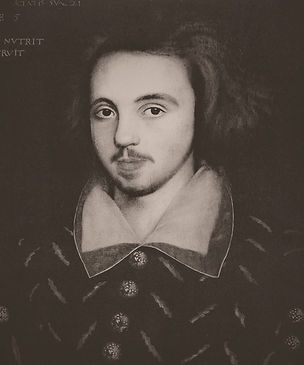
Francis Bacon and Christopher Marlowe were the foremost figures of the great unknown concealed by the name 'William Shakespeare'. Their two incarnations were oversouled by the Dhuman-Adamics El Amenu and Thanatu. El Amenu is the eighth Osirian Adept of Atlantis and Thanatu the fourth Osirian Scarab. We next look at their associated incarnations through several ages — from the psalm writers of King David to the great dramatists of Greek tragedy; from Dante to the Count Saint-Germain.
"We are such stuff
As dreams are made on; and our little life
Is rounded with a sleep."
— Shakespeare, The Tempest, c.1611, IV:i

Primary source via El Aurenx et al, Esoteric Biographies, unpublished MS, c.2000.