8
Recurring
"Gilgamesh, where are you hurrying to? You will never find that life for which you are looking ... Cherish the child that holds your hand, and make your wife happy in your embrace; for this too is the lot of man."
— Epic of Gilgamesh, Tablet X, c.3000 BCE
Collaborations


Gilgamesh and Odysseus
The travails of both Gilgamesh and Odysseus, two epics set millennia apart, portray a powerful king on an agonising journey home following the ill-fated death of his companion/compatriots. While both arrive alone and empty handed, their homecomings differ significantly. Gilgamesh returns with newfound wisdom having learnt that immortality is impossible and that death is the inevitable fate of all mankind. Odysseus returns with humility, having learnt that a home and a hearth are more important to human life than glory or immortality.
Scholars have long noted that the heroes' wanderings feature nearly identical archetypal landmarks: both travel to the edge of the world/underworld, both are waylaid by divine/supernatural women, and both suffer the consequences of their companion/compatriots' actions. Both return to their respective cities (Uruk and Ithaca) permanently changed, shedding reckless arrogance for tempered compassion.
We share here some recent, and as yet unpublished, karmic insights:
"Gilgamesh and Enkidu are mythical characters from ancient Sumerian-Akkadian lore, most notably found in the Epic of Gilgamesh, but based on the legendary lives of the Dhumans Udussaiu (Odysseus) and Urus (Oros). The myths represent composite lives with similar initiatic themes enacted over several incarnations; from ancient Atlantis to the post-diluvian civilisations of Mesopotamia and the Mediterranean.
There was nevertheless a historical Gilgamesh (Bilgames), king of Uruk c.3000 BCE, who lent his name to the eponymous epic and an actual companion, Enkidu. They reappeared in Homer's Odyssey as Odysseus and his brother-in-law and second-in-command Eurylochus. While Enkidu is depicted as Gilgamesh's loyal servant and companion, at whose death Gilgamesh is left bereaved, Eurylochus is portrayed as being often at odds with Odysseus and in some ways an antihero — reflecting a variation in the initiatic role-play. Even in their eventual association as Gurdjieff and Ouspensky, their once close guru-disciple relationship ended in estrangement." (El Ochre, 7 September 2026)


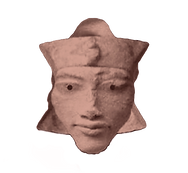

George Gurdjieff (c.1870s – 1949) is known to have used the Epic of Gilgamesh as an example of how ancient spiritual knowledge was preserved over millennia. In his autobiographical book Meetings with Remarkable Men (1963), he explains that his father was an ashokh (bard or storyteller) who could recite ancient legends at length, including the Epic of Gilgamesh, which had been passed down orally from generation to generation.
Years later Gurdjieff recounts how, on reading the newly translated Babylonian clay tablets, he was astonished to find that the written text matched the oral version his father had recited to him as a child. For Gurdjieff it was proof of a concept he called legominism — a deliberate method used by ancient initiates to transmit cosmic laws and sacred wisdom through unchanging oral narratives, poetry and art.
Biographical accounts note that Gurdjieff came from an "antique patriarchal world where children were put to sleep at night with the story of Gilgamesh". (P L Travers, Man, Myth and Magic, 1970) Gurdjieff integrated elements of Mesopotamian lore, traditional fables and oral myths into his esoteric system — the Fourth Way — which Peter Ouspensky (1878 – 1947) famously recorded and systematised through books such as In Search of the Miraculous (1949).

_edited_edited_edited_.png)
Amarsin and Homer
"When it comes to works of this kind [The Epic of Gilgamesh and The Odyssey], there is usually an antecedent tradition stemming from the historical time and perpetuated through multiple fables and legends, both oral and written, until one or other definitive version may arise as the work of one or more authors. Take the Arthurian tales for example: from the time of the historical King Arthur which we place in the 5th – 6th century CE, bards have sung the sagas — a mixture of fact and fiction — from which later writers wrote various versions until Thomas Malory produced a definitive corpus, drawing upon available sources and reworking them with additions and adaptations according to his own creative inspiration. Other examples are the collection of fairy tales by the Brothers Grimm or Hans Christian Anderson, or the fables attributed to Aesop. My point is that there simply is no one original author.
The Epic of Gilgamesh as it has come down originated from many legends that sprang from the time of Gilgamesh, the historical king of Uruk (Erech) c.3000 BCE. The definitive version was eventually produced around 1200 BCE and attributed within the text to Sinliqunninni (Sin-leqe-unnini), an Akkadian priest who translated and edited surviving Sumerian fragments of the legendary tales. Although he is regarded as the sole author, he had help from a team of co-workers in collecting and collating the source material. 'Sinliqunninni' is a priestly name invoking the moon god Sin, meaning Sin hears my prayer. Like 'Shakespeare', it is a nom de plume which can refer to the team or to the team leader [see Shakespeare]. The real name of the prime author was Amarsin (Amar-Sin), an incarnation of El Emire, who reappeared as Homer [Homeros] in the 8th century BCE. Similarly, with help from his co-workers (the reincarnations of the same team), Homer produced the definitive version of The Odyssey, a sequel of course to The Iliad. El Emire is the eminent genius behind both Epics." (El Ochre, 1 October 2026)

Syncretism
The defining moment in Odysseus’ homecoming is the stringing of his hunting bow before his wife and rival suitors in the great hall of his palace (Book 21). The dramatic scene serves as the symbolic climax of his epic journey, identifying him as the rightful king of Ithaca. Likewise, in the Arthurian legend cycle, the drawing of the sword from the stone is the defining moment in which young Arthur proves his royal birthright to the throne of Britain. While these archetypal scenarios may be understood in terms of Jung's collective unconscious or Joseph Campbell's hero's journey, we wish to posit here that they are also the outcome of inspired authorship by overarching and interconnected Dhumans — the immortal guiding spirits or tutelary genius behind mortal humans.
As noted under Keywords, dhumans assist humans in their earthly endeavours and creativity, and have done so since the dawn of time. Whether discarnate or incarnate, they are always spiritually connected to other souls in their care and to their fellow oversouls. Oversouled lives can be best described as karmic collaborations whereby dhuman oversouls and human souls function as one personality, usually incarnate together, with each contributing to their character and to their karmic propensities.


"The journey of the hero is about the courage to seek the depths; the image of creative rebirth; the eternal cycle of change within us; [and] the uncanny discovery that the seeker is the mystery which the seeker seeks to know."
— Joseph Campbell, The Hero’s Journey, 1990
Symbolism
Is it possible that the hero's quest for immortality symbolises the longing of a soul (psyche) for its immortal self? If so, could the journey undertaken by Gilgamesh represent his search for himself as Udussaiu, for his own eternal self or Oversoul?
Later, when Gilgamesh returns as Odysseus, he rejects the offer of immortality and eternal youth, choosing instead a finite, mortal life so that he can return home to his wife and son — setting temporal relationships and responsibilities above an endless, effortless existence in paradise or a wispy, shadowy afterlife without moral reward. (In the Homeric afterlife a king, beggar, coward and hero all share the same eventual fate.) Odysseus' homecoming (nostos) thus represents his desire to live life fully in the present, despite all its pains and troubles.
In turn, Gurdjieff rejected interpretations of heaven and hell as a primitive reward-and-punishment duality. He provocatively taught that the immortality of the soul is not a birthright but something an individual must actively nurture and develop. It was Gurdjieff's unique way of awakening others to undertake life’s epic journey consciously.