5
Returning
"The seeds of the past bear fruit in the present."
― Joe Abercrombie, The Blade Itself, 2004
Compariots


The Founding Fathers of America
In the little Macedonian town of Mieza, between 343 – 340 BCE, the great philosopher Aristotle tutored a small group of boys at the behest of Philip II, king of Macedon. The youths included Philip's sons Alexander and Arrhidaeus, along with the sons of nobility such as Ptolemy, Hephaestion, Seleucus, Lysimachus and Cassander. Out of this elect group would emerge Alexander the Great and the great generals who were to inherit his empire after his death. They would reappear together as Thomas Jefferson, John Adams, George Washington, James Madison, James Monroe, John Jay and Aaron Burr, among others. If the seeds of Aristotle's moral teachings did not germinate and bear much fruit in the time of Alexander and his Companions, perhaps they did so with a greater measure of maturity during their lives as the founders of the United States of America. These lives are shared by El Ochre and El Aurenx (c.1997, 2025).

Thomas Jefferson
From a transpersonal perspective, Alexander the Great can be seen as a founding father of several epoch-making empires. His last appearance was as the eminent Thomas Jefferson (1743 – 1826). He was an American revolutionary leader, political philosopher and among the most brilliant American exponents of the Enlightenment. He was also the main author of the Declaration of Independence and the third president of the United States. Jefferson had previously been Sir Walter Raleigh, half-brother of Sir Humphrey Gilbert, the two Elizabethan adventurers who promoted the first colonization of America by the English. (Their former lives together can be traced back to Byzantium, Rome, Persia and Egypt; but that’s the subject of a forthcoming post. Gilbert would return as George Washington.

George Washington
After commanding the American War of Independence, George Washington (1732 – 1799) became the first president of the United States. Washington was a reincarnation of Ptolemy, one of Alexander's closest friends from youth and one of his most trusted generals. Ptolemy acquired Egypt as his portion of the empire and, as Ptolemy I Soter, founded the Ptolemaic dynasty into which Alexander himself later reincarnated as Ptolemy III Euergetes — generally considered the greatest of the Ptolemies.

Benjamin Franklin
Benjamin Franklin (1706 – 1790) was a polymath of many accomplishments — printer, author, diplomat, philosopher, scientist — and a great statesmen whose diplomatic efforts helped end the Revolutionary War and lent recognition to the United States as an independent nation. He was also among the signatories to the Declaration of Independence and contributed to the drafting of the American Constitution. He was a reincarnation of Ptolemy II Philadelphus, son of Ptolemy I and the father of Ptolemy III.


John Adams
John Adams (1735 – 1826) was a reincarnation of Philip III Arrhidaeus of Macedon, son of Philip II and the older half-brother of Alexander the Great. According to Plutarch, Alexander's mother Olympias attempted to eliminate her step-child Philip as a rival to her own son by poisoning him, and as a result Philip was rendered mentally handicapped and epileptic. Nevertheless, the two half-brothers were close and grew up together. Philip accompanied Alexander on some of his campaigns and was with him in Babylon when he died. Philip was proclaimed king of Macedon, supported by Ptolemy; but he was never allowed to be an effective ruler, and reigned only in name with the real power held by a succession of generals who constituted a regency.

Philip’s wife and queen consort, Adea Eurydice, belonged by birth to the Macedonian royal dynasty and managed to insinuate herself into the regency. She strove to mitigate the power of the regent generals in support of her husband's sovereignty. However, her life was beset by political intrigues after Alexander’s death, including a plot by his mother Olympias and his widow Roxana to replace his half-brother Philip on the throne with their posthumous son and heir, Alexander (later reincarnate as Alexander Hamilton). In the end Olympias had Philip and Eurydice imprisoned and executed, Eurydice by forced suicide. Alexander IV became a boy king with Olympias as regent. But the tide turned when Cassander seized power and eventually executed Olympias, Roxana and the 14 year-old Alexander — thus the mother, wife and 14 year-old son of Alexander the Great. As a founding father, Adams was a senior figure in the Revolution and served as a diplomat in Europe. He became vice president to George Washington and, later, was his successor as second president. Adams relied much on the advice of his wife Abigail, a reincarnation of Adea Eurydice, and that of his friend and rival Thomas Jefferson (a former half-brother), who became his vice president and, in turn, his successor as third president. Adams encountered much criticism from his opponents, including a faction within his own party led by Alexander Hamilton.




Alexander Hamilton
Alexander Hamilton (c.1757 – 1804) was a reincarnation of Alexander IV, posthumous son of Alexander the Great. Illegitimate and orphaned in childhood, he was from his youth an ardent campaigner for the Revolution and served in the War as an officer and aide-de-camp to Washington. He became the first Secretary of the Treasury and subsequently one of the founders of the Federalist Party opposing Jefferson's Democratic-Republican party. Hamilton was ultimately killed in a duel with his fierce rival, Jefferson's vice president Aaron Burr, the reincarnate Cassander (see coloured engraving by unknown artist, American School. 19th century).


Aaron Burr
Cassander supported Philip III Arrhidaeus as king and was embroiled in the conflicts that ensued among the regents. He ultimately executed Olympias who had murdered Philip and his wife Eurydice, and later executed Roxana and Alexander IV. Aaron Burr, the reincarnation of Cassander, served as an officer in Washington's army. As a politician he was one of the founders of the Democratic-Republican party but ran for president against Jefferson to succeed Adams — which ended in a tie, requiring a vote in the House of Representatives. Hamilton of the opposing Federalist party, despite his opposition to Jefferson, deeply distrusted and despised Burr and ensured Jefferson's election. Burr as the electoral runner-up served as Jefferson's vice president, although the two were often at odds and Jefferson dropped Burr as his running mate for his re-election. The political enmity between Burr and Hamilton became increasingly personal and acrimonious, resulting in the duel that claimed Hamilton's life and ended Burr's political career. Burr went on trial several times for treason, an alleged conspiracy to take over the country, but was acquitted. Burr is nevertheless honoured as among the founding fathers.

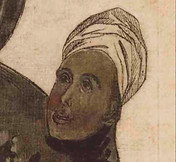
Coincidentally, Alexander the Great and his wife Roxana of Bactria (today Cenral-South Asia) came together again as Thomas Jefferson and his slave paramour Sarah 'Sally' Hemings. The seeds of Aristotle's teachings seem to have found fruition in Jefferson who was not like Alexander the Great a vainglorious warlord, but an enlightened thinker and champion of progressive and liberal policies. A true appreciation of their relationship has been overshadowed by the politics of race, gender and enslavement — both then and now. There is only one contemporary portrait of Sarah Hemings (see detail of coloured engraving by James Akin) which appeared with text from the first scene of Act 1 in Joseph Addison’s drama, Cato: “Tis not a set of features or complexion or tincture of a skin that I admire.” The print was published around 1804.
Like Cato the Younger, Washington was known for his active commitment to Republican ideals and public virtues. Both men were ardent advocates for liberty and upheld traditional Roman values, notably against their disrespect or decline. Both were known for their honesty, integrity and bravery in the face of powerful enemies. As Commander of the Army and, later, as US President, Washington regularly cited Cato in his letters and speeches.
While similarities between the two are strong, so too are those between other Founding Fathers and several Roman Republicans. So much so that in Jefferson's day speculations abounded about his past incarnations as Roman statesmen, Cato and Lucius Quinctius Cincinnatus. What we do know is that Washington had not been Cato but his contemporary, Hirtuleius, the loyal lieutenant who defied the power of Rome when it went into decline. Similarly, Washington fought against the English crown he had once so ardently promoted as an Elizabethan adventurer. Karma clearly has a way of turning events around to maintain a fair balance of power in the world.

Dean Morrissey, Secrets of Monticello, giclée, 2015.

James Madison
Jefferson's lifelong friendship with his Secretary of State and his chosen successor as fourth president, James Madison (1751 – 1836), recapitulates the close friendship between Alexander the Great and Hephaestion. Hephaestion was "by far the dearest of all the king's friends; he had been brought up with Alexander and shared all his secrets." (Curtius, Histories, 3.12.16) Hephaestion distinguished himself as a soldier, engineer and diplomat and kept a keen interest in philosophy, continuing a correspondence with his former tutor Aristotle. Alexander and Hephaestion often compared their friendship to that between Achilles and Patroclus, and Alexander is said to have held Hephaestion to be his alter ego. Hephaestion died suddenly and left Alexander grief-stricken. Alexander himself died 8 months later.
Madison, the reincarnation of Hephaestion, distinguished himself as the Father of the Constitution and the Bill of Rights. He is also lauded for the 'second war of independence' (1812) against Britain.
_edited_.jpg)
James Monroe
James Monroe (1758 – 1831) became the fifth president of the United States, the last of the Founding Fathers elected to lead the country. Like his predecessor Madison, Monroe was a protégé of Thomas Jefferson under whom he studied law. Monroe fell out with Madison over the treaty Monroe negotiated with Britain, but still went on to serve simultaneously as Madison's Secretary of State and Secretary of War. Monroe promoted the colonisation of Africa by freed slaves. He was a Freemason, and after his death was attacked by clergy for having "lived and died like a second-rate Athenian philosopher" (1832). Monroe was a reincarnation of Seleucus, one of the regent generals that became ruler of the eastern empire after Alexander's death. As regent, he would eventually be assassinated. However, ever loyal to his leader, he joined forces with Cassander, Ptolemy and Lysimachus to defeat Antigonus, a powerful general who had gained control of most of Alexander's empire but who, ironically, died fighting for a realm that was not his to take.


Lysimachus gained the territories between the Black Sea and the Mediterranean. His reign was beset by domestic troubles during which he put to death a number of those he believed were conspiring against him. His actions were seen as treacherous, and as a result there were many outbreaks of revolt. As a result, many of his trusted friends deserted him, some fleeing for refuge to Seleucus. Seleucus and Lysimachus were at war with each other and, as another ironic twist, Lysimachus died in battle fighting against his former friends.

John Jay
Lysimachus was reincarnate as John Jay (1745 – 1829), a Founding Father of America who contributed to draughting a new Constitution and became the first Chief Justice of the Supreme Court. However, unlike Lysimachus, Jay was not overly ambitious; he never bid for the presidency and was content to serve as governor of New York, after which he retired from politics to his farm. He died after suffering a stroke. Perhaps the seeds of Aristotle's moral teachings had found fertile ground in him more than in most, as expressed in his Christian piety: "No human society has ever been able to maintain both order and freedom, both cohesiveness and liberty apart from the moral precepts of the Christian Religion. Should our Republic ever forget this fundamental precept of governance, we will then be surely doomed."
Thomas Paine
Not all Founding Fathers were devoutly Christian. Several were enlightened free-thinkers, none more so than Thomas Paine (1737 – 1809). Paine published pamphlets promoting the ideals of freethought and freedom. He was active in both the American and French Revolutions. His critical outspokenness alienated many former allies by whom he felt betrayed. He even published an open letter denouncing Washington as an incompetent general and a hypocrite. Paine was a reincarnation of Cleitus the Black (so called to distinguish him from another Cleitus the White) who once saved the life of Alexander the Great only to be killed by him a few years later in a drunken row, when he denounced Alexander as an illegitimate king who owed all his achievements to his father, among other grievances. The enraged Alexander hurled a pike at him, fatally wounding him (see illustration by William Rainey, 1900, below). Alexander instantly regretted it and wanted to take his own life there and then, but was restrained by his men. Paine was also the reincarnation of Marcion of Sinope, a second century Christian theologian whose Marcionism was deemed heretical for denouncing the god of the Old Testament as a demon. Paine echoed these sentiments in virtually the same terms and continued his denunciation of organised religion and dogma.


Primary source El Ochre, 24 April 2025
Addendum

Pierre L'Enfant
"An article popped up on Google and caught my eye — Apollodorus of Damascus: The Ancient Greek Genius Who Made Rome Great — viz. the great architect and engineer who served emperor Trajan and his successor Hadrian, 2nd century CE. While learning about his career, El Ochre suddenly interjected: 'Thus he was also Pierre L'Enfant, the architect of Washington.' I subsequently read the wiki articles on both architects, hitherto unknown to me, and noticed several parallels:
Apollodorus was responsible for Trajan's expansive architectural and engineering projects and continued his career under Hadrian. He ultimately offended Hadrian who banished him and later ordered his death (the latter point disputed by modern historians). As we already know, Trajan and Hadrian returned as Thomas Jefferson and George Washington. Similarly, under President Washington and his Secretary of State Jefferson, L'Enfant was responsible for the original design of the nation's new capital but was eventually dismissed by Washington for his insubordination. Fascinating parallels." — Laurence Oliver, 2 August 2025
Ita Wegman and Rudolf Steiner
Alexander's father and mother were not reincarnate among the Founding Fathers of the 18th century. The polygamous Philip II reappeared in the 19th century as Crown Prince Rudolf of Austria whom Steiner identified as a reincarnation of emperor Nero, but mistakenly so. The prince appears to have been a pseudo-Nero impostor, a Roman soldier named Terentius Maximus, also an incarnation of king Philip. Rudolf died in an apparent suicide pact with his mistress, Baroness Marie Vetsera, probaly one of Philip II’s fomer wives. He had been married seven times. See Returning Families for more information on his transpersonal lives.
Alexander's mother, Olympias, is said to have returned as Ita Wegman, the intimate associate of Rudolf Steiner, himself the reincarnation of Aristotle. We look at the return of Olympias and her female contemporaries under Recurring Collaborations.


Primary source El Ochre, 24 April 2025