8
Recurring
Collaborations
"Intimates of esoteric schools of knowledge have always known, as others have sometimes surmised, that this 'great unknown' is greatly known, but by another name."
— Laurence Oliver, The Lives of the Great, c.1997, unpublished manuscript
Christian Rosenkreuz
His name is mysterious, well-known yet unknowable, while his presence is both obscure and ubiquitous. Even his initials CRC seem secretive, like an ideogram. He is usually presented as a 15th-century German mystic who, after travelling around the Middle East, North Africa and Spain in search of lost or hidden knowledge, became the founder and figurehead of Rosicrucianism — a secret brotherhood said to possess the occult teachings and esoteric wisdom of the ancient Orient. But is he a real historical figure?
According to C W Leadbeater, the Ascended Master behind this enigmatic figure is known to history as Comte de Saint Germain, aka Master Rakoczy, in the eighteenth century. Before that he was Francis Bacon in the seventeenth century, Robertus the monk in the sixteenth, soldier János Hunyadi in the fifteenth, Christian Rosenkreuz (CRC) in the fourteenth and Roger Bacon in the thirteenth. He is the Adept of the Occult World. Further back in time he was the great Neoplatonist Proclus and, far earlier, the first-recorded Christian martyr in Britain, Saint Alban. (The Masters and the Path, 1925, p.258)


We have no wish to contest or dispute Leadbeater's account of these past lives. It suffices to show a continuous sequence of incarnations through the centuries. A hundred years on, here's what we know about the Osirian Adept (in Leadbeater's terminology a Master or Ray) behind Christian Rosenkreuz:
"Behind the name Christian Rosenkreuz is a being called El Amenu. El Amenu usually appears as a Teacher of the Occult. Such was his role in Atlantis, so that he was identified by the name Amenu which means A- (Un-) Menu (Manifest); that is to say, Hidden, Concealed or Occult. Such was his role again in Egypt, and again and again in after ages.
He inspired the Rosicrucian movement of the middle ages in Europe. As Francis Bacon he presided over another cycle of Rosicrucian activity in the Elizabethan age. Bacon authored the Rosicrucian manifestos in which he alluded to Christian Rosenkreuz as the founder of the Rosicrucian Order in the thirteenth century. But there was no actual incarnate person as Christian Rosenkreuz. Bacon used the name symbolically (as he did with the name Shakespeare in another context) to refer to himself as El Amenu, as the inspirational figure behind the movement.

In his subsequent incarnation as Count Saint-Germain he was widely identified in Rosicrucian circles as a reincarnation of Christian Rosenkreuz. The symbolic name became most commonly known in this German form, although the Rosicrucian manifestos were disseminated in several languages among the occult groups of Europe, and with corresponding variants of the name, but the German version leaked out to the public unintentionally.
The German Grand Master Johan Valentin Andreas did some damage control by assuming responsibility for the authorship of the manifestos and dismissing them as nothing more than a fictional play (ludi). And that is the official position accepted by historians. But Francis Bacon as Grand Master in England was the real author, and he became the Supreme Grand Master of the Order for the whole of Europe.
With all this I am merely showing how names and figures can be used symbolically in certain paradigms to typify inspirational sources of knowledge or wisdom, and need not necessarily be taken literally." (El Ochre, 25 February 2023)
"The Comte de St Germain was certainly the greatest Oriental Adept in Europe during the last centuries."
— Helena Blavatsky, The Secret Doctrine, 1888

The two portraits shown here were supposedly identified by Steiner as portraying Christian Rosenkreuz and Count Saint-Germain respectively. The upper drypoint etching by Rembrandt is usually described as A Man at a Desk Wearing a Cross and Chain, dating from 1641; and the lower painting formerly known as an ancestral portrait from the Lerchenfeld family, alas now lost. While staying on the Köfering estate of Count Lerchenfeld, Steiner allegedly remarked to him: "This is not a Lerchenfeld ancestor, it is the Count Saint-Germain". (Zaiser, 1969)
Let us stress again, we are not here to judge statements made by Theosophists or Anthroposophists, but merely wish to show what an enigmatic figure he has been and that his portraits are laden with spiritual significance, whether they be true portraits or not. Like the legends surrounding a figurehead, such prized images are imbued by spiritual powers and infused with benign potency. Let them be what they are taken to be. (El Ochre, 26 October 2024)

We return to Rembrandt's portraits further below. For now we offer a brief overview of the origin and spread of Rosicrucianism.
Rosicrucianism
"Rosicrucianism is itself very ancient and was the fountainhead from which sprung the mystical schools and secret traditions of Antiquity. It was the underground stream of the Hermetics.


The earliest traceable source comes from the Atlantean legacy of ancient Egypt, where it gave rise to the mystery schools of Ros-Tau, the Solar Cross. The symbol of the crucified sun was later represented as a crucified red rose. Ros-Tau was also an ancient name for the Giza complex of pyramids and temples. The site of Rosetta, where the famous stone inscriptions were discovered, was once called Ros-Tau. The Arabs referred to it as Rashid, this being the nearest equivalent in their language. By this odd coincidence the Rosetta Stone — which was to unlock the secrets of Egyptian hieroglyphics — could be called the Ros-Tau Stone, or the Rosicrucian Stone.
Rosicrucianism spread in waves through the religious cultures of all the high civilisations in the Old World, inspiring the revolution of Akhnaton in Egypt’s eighteenth dynasty and the religion Moses bequeathed to the Hebrews. Among the Israelites it became the Kabala, the Hidden Teaching, held in trust by the Essenes of Palestine and the Therapeuts of Alexandria. It was the inner teaching of the Greek philosophers and, later, of the Neoplatonists and Gnostics. In Christianity it informed the heretical doctrines of the Arians, Manichaeans, Nestorians and Cathars. In Islam it was the mysticism of the Sufis, the wine that existed before the grape and the vine — that is, the timeless wisdom older than any school or tradition."
— Laurence Oliver, cited in Knot of Stone, 2011, p.267


Rembrandt
Rembrandt's enigmatic portrait of The Polish Rider (c.1655), formerly known as a 'Lisowczyk' or 'Cossack on Horseback', has been linked to various historical figures through the centuries — from the biblical David (shown below, with Jerusalem in the background?) to the exiled Gijsbrecht IV of Amstel (below, at Holąd Pruski, aka Prussian Holland, a Dutch settlement he supposedly founded in Poland?). There are other candidates, of course, but we need only concern ourselves with two: Marcjan Aleksander Ogiński and Christian Rosenkreuz.

Marcjan Aleksander Ogiński was a Polish-Lithuanian nobleman, statesman and military commander who had, in his early twenties, studied artillery and fortifications in Holland. Like his compatriots, he stayed in Amsterdam and had his portrait painted, including one by Ferdinand Bol, a former student of Rembrandt. Rembrandt's own portrait of Ogiński, if that's who it truly is, was left unfinished when the young, talented soldier rejoined his unit following the Swedish invasion of his homeland in 1655. (Juliusz Chrościcki, Polish Rider: Allegory or Portrait, 1981) Scholars today continue looking for clues, including other candidates, but Ogiński still remains the most compelling subject for this painting.
On the other hand, Anthroposophical lore has it that Steiner identified The Polish Rider with Christian Rosenkreuz and likened the building on the distant hill to the first Goetheanum in Dornach. However, there appears to be no record of him making either claim in any of his lectures or correspondences. The hurriedly completed background was probably done by a fellow artist or student to help sell the work during Rembrandt's bankruptcy in 1656. The building appears to be based on an earlier painting, dating from 1642, showing David and Jonathan before the city of Jerusalem (see detail of Solomon's temple below). Curiously, Rudolf and Marie Steiner presented Rosenkreuz as the reincarnation of Hiram Abiff, architect of the Temple in Jerusalem, and called him the spiritual 'Guardian of the Goetheanum'.


"I will wait for this knight,
he shall be my champion."
— Richard Wagner, Lohengrin, 1850, I:ii cited by Steiner on a reproduction of Rembrandt's A Man in Armour, 1655
Steiner inscribed these words on a card he gave to Harriet von Vacano, c.1923. His intention was not to compare Rembrandt's Man in Arms with Wagner's Swan Knight, but to link the enigmatic portrait with the mysterious Christian Rosenkreuz; also called the Unknown Knight or Young Warrior.

Steiner apparently repeated the Rembrandt-Rosenkreuz link on several occasions, including once with Helga Geelmuyden in Oslo, also around 1923, when he promised to send her a card on his return home. She had shown him a portrait of Count Saint-Germain, possibly obtained via the Theosophical Society, to which he reportedly replied that he had "a much better picture of CRC's previous Dutch incarnation". Steiner did not specify further. Alas, nothing was to come of it due to his lingering illness and untimely death two years later. Geelmuyden died in 1951 without knowing which portrait Steiner had intended for her. (Ernst Lehrs, Gelebte Erwartung, 1979)
Recalling this incident thirty years later, Ingeborg Möller-Lindholm insists that "the Dutch incarnation certainly has something to do with the Unknown Knight of Rembrandt". She goes on to add that an Anthroposophical art historian(?) claimed to have found a margin note by Rembrandt at the national archives (RDK) in The Hague which says: "Portrait of the one who taught me the secret of chiaroscuro". (Möller-Lindholm, private letter to Karl Heyer, 11 January 1952) Other versions claim Rembrandt left an inscription behind A Man in Armour that reads: "This is the man who taught me about light and dark". No such message has ever been found in any inventory or behind any canvas made by Rembrandt. Nor has anything similar been recorded by archivists or museum curators, anywhere.
Around this time, c.1950s, everything changed — recollections turned to speculations and speculation led to invention — until it all blended seamlessly. As it still does today. A key figure in this process was the author Gerlind Zaiser who published plays and performed recitations dealing with Rosenkreuz's different incarnations. She embellished events and created scenarios, including a nocturnal meeting between Rembrandt and Rosenkreuz. (Blätter für Anthroposophie, July 1956, pp.259–261) All this would be fine if it remained in the realm of the imagination, a sort of tableaux vivant, but Zaiser presented it as claircognizant facts confirmed by documentary proof. To date no evidence has surfaced to support her.
Yet belief in Rosenkreuz's manifestation and Rembrandt's annotation prevail among acolytes. A similar misconstrual applies to The Man in a Golden Helmet (c.1650), a work no longer considered to be by Rembrandt, but still linked to Rosenkreuz as an embodiment of the Spiritual Soldier. Be that as it may, these misconceptions are the stuff of intra-anthroposophical debate. For a critical analysis of Zaiser's zealous reconstructions and fanciful inventions, see Hella Krause-Zimmer, Christian Rosenkreutz (sic), 2011; and Christian Lazaridès, Seven portraits with complicated destinies, 2012. Weighing in on this debate, Rembrandt scholar Dirk Vis argues that "any identification with Christian Rosenkreuz is a fable without foundation". (Das Goetheanum, 38, 1984, pp.294–296)


_-_The_Man_with_the_Go.jpg)


These misconceptions have spread far beyond a few articles in Das Goetheanum. They are copied and repeated uncritically online. Misinformation is prevalent. Anthroposophical interventions can be found everywhere, including Wikipedia, with AI accelerating this process. Here it is stated that Steiner explicitly identified A Man in Armour as a contemporary portrait of Christian Rosenkreuz in his lecture on Esoteric Christianity and the Mission of Christian Rosenkreutz. (GA 130, III:I, 27 September 1911, Neuchâtel) While search results confirm this attribution, the exact words spoken by Steiner cannot be found. No citation exists? The context, however, indicates his identification was made to emphasise the continuous presence and mission of this spiritual leader through the ages.
To add to the confusion, A Man in Armour is also identified as Alexander the Great, although it was never named as such by Rembrandt. Nor do we know if it is an actual portrait. While it may have been inspired by the idea of Alexander, art historians generally regard it as a portrayal of a classical hero like Achilles or the Roman god of war Mars. Some scholars see it simply as an allusion to antiquity, a mere allegory, as was then the Baroque fashion, with Rembrandt's son Titus serving as a costumed model, dressed à l’antique.
The painting should not be confused with an earlier portrait of Alexander the Great, better known by its Italian title, Alessandro Magno, and dated 1661, alas now lost. It was commissioned by the Sicilian collector Antonio Ruffo and, so far as we know, showed the Macedonian hero seated with a sword and lance at his side. The painting was probably destroyed by fire during the 1783 earthquake in southern Italy. In short, the Alessandro Magno is not the same work as A Man in Armour and identification with Alexander the Great is thus misplaced.
It is therefore perplexing to hear it said that Steiner himself identified this painting as a portrait of both Alexander and Rosenkreuz. If indeed he ever made such claims. If he did, then what occult knowledge was he privy to that remains unknown to art historians today? The link to CRC was certainly made after his death by Marie Steiner who, when speaking to select members of the Anthroposophical Society, referred to A Man in Armour as the 'Knight of the Spirit' aka Christian Rosenkreuz. (Das Goetheanum, 2:48, 29 November 1925) In her day reproductions of the painting were shared secretly or exchanged only between confidantes: "We initially showed them in discreet ways or used them during esoteric lessons; but now they are reproduced often...". (Marie Steiner, private letter, 29 September 1948)


Whether these be portraits of Christian Rosenkreuz or not, the paintings are "carriers of occult forces" (Lazaridès, 2012) and, at best, should be viewed symbolically. They are sources of inspiration for many, not only for Anthroposophists, and their supposed identities or personages need not be taken literally. So let them be what they are taken to be.

Like the mystique that came to enshroud the lives of Kaspar Hauser and Trevrizent, so too the enigma of Christian Rosenkreuz captured the imagination of Steiner’s circle and led to a shared conviction that Rembrandt was inspired by a visitation of Rosenkreuz in the mid-17th century. The last hundred years has shown that our desire for esoteric enigmas is stronger than our need for the truth. But more to the point, the truth behind the real Kaspar Hauser is less important than the good this inspirational figure offers the world; particularly as a role-model for the physically disabled and mentally disadvantaged (he is patron of the international Camphill Movement). The truth behind Trevrizent is that he is not a historical figure as such but rather a type, or even an archetype, of the Hermit icon, and there are many who would identify with him. The semi-fictional character and events of their lives, including those of Christian Rosenkreuz, should not be taken too literally. They are a mixture of historical facts, fantasies and fables. Their purpose is therefore transpersonal rather than personal, by which we mean to say these figures and dramas are transcendental. (El Ochre, 26 October 2024; El Amenu, 3 April 2023)
We have no wish to dispute Steiner's karmic insights or the extrapolations that later emerged around Rembrandt and Rosenkreuz; including their alleged reincarnations as Mani-Parzival and Lazarus-John respectively. Nor do we wish to engage in the intrigues of Anthroposophists, past or present. We wish only to convey what we have come to know via our own sources, independently, and without prejudice. We leave our readers to decide for themselves.

Addendum
We began this page by saying that behind the name 'Christian Rosenkreuz' is a being called El Amenu, Teacher of the Occult, whose role it was to reveal the hidden knowledge of Atlantis and Egypt, again and again in after ages, using various pseudonyms or aliases as suited the occasion. He is both 'greatly known as the great unknown' and, as Steiner put it, one of the 'great leaders of humanity' (Peter Selg, 2012). We conclude with some new insights garnered from El Ochre prior to this publication:
"There was no seventeenth century Dutch incarnation of El Amenu, neither did El Amenu discarnately oversoul or influence Rembrandt. No portraits by Rembrandt are meant to depict Christian Rosenkreuz. Rembrandt's portrait of the Polish Rider (finished by his pupil Willem Drost) is indeed of Marcjan Aleksander Ogiński. The Man in Armour does not depict Christian Rosenkreuz or Alexander the Great but is simply A Man in Armour."
— El Ochre, dialogue with Laurence Oliver,
13 December 2025
We take a closer look at the diverse incarnations of El Amenu (Francis Bacon) and his collaboration through the ages with fellow Osirian Adept Thanatu (Christopher Marlowe) on another page. Go to here.

As shown by The Cosmologists, modern astronomers can be traced back to their incarnations as ancient philosophers. The Prometheans, similarly, have shown how classical composers and painters can be identified with Classical Greek dramatists and tragedians. These lineages track the trajectories of their Oversouls (Dhumansor Rays), not their individual human souls (divine sparks). We now look at both souls and oversouls and their interactivity via the lives of several creative thinkers.


Dante, Goethe and Jung
Most human souls are oversouled by Dhumans, either individually or in groups, including select soul clusters that incarnate together in recurring cycles over extended periods of time — usually with a specific purpose. Like a distant star cluster, one such group was recently found around the Dhuman oversouls of Thanatu, El Doran and Arjuna (see diagram below). We begin with CG Jung:
"Jung told me that in a former life he had been Paracelsus. He said, 'I know it because of my inner experiences, which match exactly the spirit of Paracelsus.' But he added immediately, 'You must never tell this to anyone as long as I live. The world is not ready for it, and it would only destroy my scientific reputation'."
— Erlo van Waveren, Pilgrimage to the Rebirth, 1978, p.23
"Both [Carl Gustav] Carus and [Carl Gustav] Jung were reincarnations of Paracelsus. Carus inherited the soul of Paracelsus. Jung inherited the oversoul [Arjun] along with the soul of Goethe. Jung was actually a descendant of Goethe — his grandfather and namesake was one of several natural offspring of Goethe's. The elder Jung was a physician and professor, and was furthermore the reincarnation of Marcantonio della Torre, a physician and professor who collaborated with Leonardo [da Vinci] on anatomical studies. Leonardo of course had the same oversoul as Goethe [El Doran] but a different soul.
The soul of Goethe [which passed to CG Jung, his great-grandson] was previously incarnate as Johann Georg Faust, a contemporary of Paracelsus and likewise a roving alchemist, apothecary, astrologer and magus with a controversial reputation — most famous (or infamous) for his legendary, though mythical, pact with the devil — the theme of Goethe's literary magnum opus. [Goethe considerably amplified the Faust legend to which he had been exposed since his youth through puppet plays and printed chap books beyond the earlier Faust poem by Christopher Marlowe, the reincarnation of Dante.]" See diagram below.

"The soul of Paracelsus [which passed to CG Carus] was previously incarnate as a contemporary, friend and mentor of Dante, not Brunetto Latini of course, but rather Guido Cavalcanti — poet and philosopher.
Cavalcanti, influenced by the Arabic psycho-physiology of Averroes, described how internal 'spirits' reacted to external sensory stimuli in a conceptual construct that prefigured the unconscious of Carus by six centuries — both contending that humans are driven by autonomous dynamics beneath the surface of conscious awareness. And Paracelsus pointed to certain diseases having roots in disturbances within the [subconscious] soul.
Jung acknowledged both Paracelsus and Carus as forerunners of his concepts. [He moreover believed that he had been Paracelsus, as cited above by Erlo van Waveren's Pilgrimage to the Rebirth, 1978.]"
Source: disclosed by El Ochre, transcribed by Laurence Oliver, 2 August 2026


Boccaccio
In his biography Carl Gustav Carrus — Doctor, Artist, Goetheanist (1999), Ekkehard Meffert notes that "Steiner confirmed the fateful connection between Dante in the 14th century and King John of Saxony in the 19th century". (book launch promotion by Thomas Meyer in The European, Vol. 4, no. 1, November 1999)
It has become Anthroposophical-lore that King John (Johann) was the reincarnation of Dante. John was born to the House of Wettin, one of the oldest dynasties in Europe, and under his government Saxony became part of the German Empire. Regarded by many as a scholar scholar-king, he studied law and humanities at Leipzig University where he famously translated Dante's Divine Comedy (1320) into German under the pseudonym Philalethes, a common alias meaning "lover of truth").
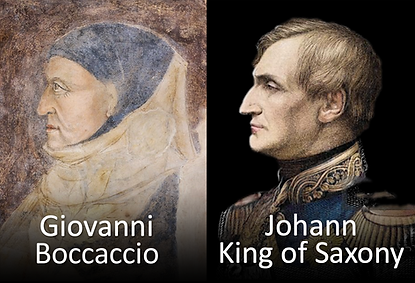

According to El Ochre et al, the divine spark soul known as Dante was oversouled by Thanatu, the fourth Osirian Scarab, who acted as the poet's incarnate guide or muse. Intrigued by the meaning behind Steiner's identification of a "fateful connection", we asked for clarification and were offered the following:
"John of Saxony was not a reincarnation of Dante, neither in soul nor oversoul, but was instead the reincarnation of Dante's younger contemporary Boccaccio. Boccaccio greatly admired Dante, and his soul imprinted the life of Dante before reincarnating as King John. This is the karmic connection that Steiner perceived but did not discern clearly enough." (El Ochre, 30 July 2026)
'Imprinting' is a new term in esoterica and occurs when one soul is allowed to share the experiences of another soul in order for it to benefit from the latter’s karma. Imprinting can be done by any soul and usually occurs between death and rebirth. The past lives which appeal to a soul can be 'downloaded' from the Akashic record, so to speak, with the result that all effect and memory of the imprinted lives will become indistinguishable from the effect and memory of the life to be lived by that soul. (El Amenu, 3 February 2023)
For more info see Imprinting.
Addendum
To complete the above profile, the second son of Thanatu, namely Karnaku, oversouled both Boccaccio and King John of Saxony:
"Thanatu and his two elder sons Thabusu and Karnaku were respectively incarnate as Dante and his younger contemporaries Petrarch and Boccaccio. The three are regarded as the pillars of the development of the Italian literary language. Petrarch held an ambivalent view of Dante as both admirer and critic; whereas Boccaccio greatly admired Dante and in his reincarnation as King John of Saxony translated the Divine Comedy into German." (El Ochre, 30 September 2026)

_edited_edi.png)
Steiner and Faust
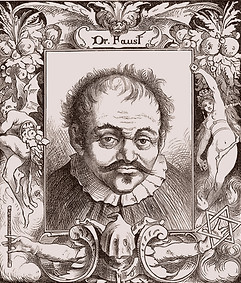

According to Rudolf Steiner, Goethe's Faust is an amalgamation of three distinct incarnations:
“In Central Europe arose the legend of the third Faust, of Johannes Faust, also called Georg Faust, who was after all a real historical figure. The 16th century legend welded together man's dread of the lower ego by fusing three Fausts — that of Augustine's Bishop Faustinus, that of Erasmus' Faustus Andrelinos, and that of Marlowe’s Johannes Faust”. (The Effect of Occult Development, GA 145, Lecture 7, 26 March 1913)
Since then we've learnt more about the Faustian legend and the three historical Faust souls:
“Faustus — a common Latin name meaning 'Favoured' — has been ubiquitous in various cognates throughout the Roman era and well after. It is ironic that one bearer of the name, because he was vilified by the orthodox Church as a heretic in league with the devil, resulted in the name acquiring an ill-favoured connotation. That man of course was Johann Georg Faust, the soul that was in Agabus, and bequeathed to Goethe and to Jung under different oversouls. As the eponymous Faust of the legend he was oversouled by Obadu, a Dhuman of the seventh generation in the line of Hermes [the second son of Osiris]. Other bearers of the name Faustus have no bearing on the legend.
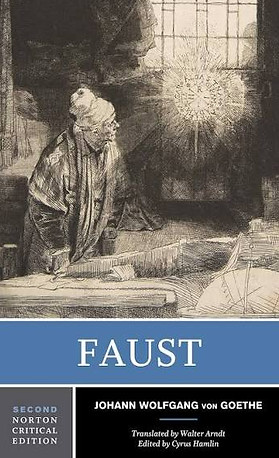
Augustine's Faustinus was a Manichean bishop who induced Augustine's disenchantment with Manicheism, but Bishop Faustinus had nothing to do with the Faust legend. Similarly Erasmus' friend Publio Fausto Andrelini was an esteemed Humanist and nothing of a Faustian figure at all.” (El Ochre, 12 August 2026) Nor the philosopher, after Rembrandt, shown alongside.
Similarly, Rembrandt's etching of The Alchemist in his Study (1652) is simply a portrayal of Doctor Fautreius, the Dutch philosopher, the title under which it appeared in Charles Blanc's catalogue (1859–1861). Despite this, it is commonly misnamed Doctor Faustus and frequently used as a cover image for studies dedicated to Faust.


Obadu
"Obadu had oversouled the soul of Faust in the era before the founding of Rome among the Italic tribe of Sabines. The Sabines were renowned for their caste of soothsayers. Faust adopted the name Sabellicus to link himself to this ancient tribe, harking back to his own incarnation among them as a soothsayer.
Again in the 6th century BCE during the reign of the 5th king of Rome, Tarquin I (whom we have mentioned in connection with the de Witt brothers), Obadu was again incarnate with this soul as the legendary soothsayer Attus Navius, a swineherd of Sabine origin who became a renowned augur, and who impressively cut a whetstone in half with a razor to demonstrate his powers to the king. Treated as folklore by later Roman writers like Livy and Cicero, this incredible story is actually quite true.
Further back in time we find Obadu incarnate in the 9th century BCE as the Biblical prophet Obadiah during the reign of King Ahab, serving as a palace steward (see sculpture alongside). During the persecution of Elijah's school of the prophets by the wicked queen Jezebel, he rescued 100 prophets and hid them in caves at great risk to himself. The book in the Bible attributed to him is a later work of the 6th century BCE. (El Ochre, 12 August 2026)


Today we know that the divine spark soul of Johann Georg Faust had previously been the 1stC Christian prophet Agabus (an incarnation oversouled by Auguru) who later returned as Goethe (oversouled by El Doran) and, again, as Jung (oversouled by Arjun). Thus one soul, four oversouls, and multiple lives. (El Ochre, 11 August 2026)